Introduction
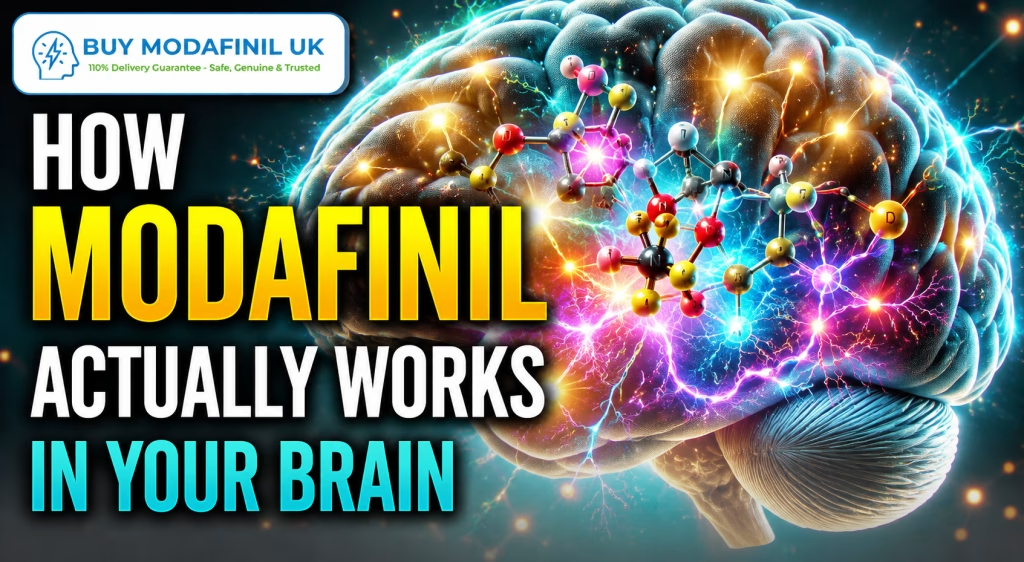
Most people know modafinil increases focus and wakefulness. But how? The mechanism is complex neuroscience. This guide explains it in simple terms – what actually happens in your brain.
The Brain Systems Involved
Three neurotransmitter systems regulate wakefulness and focus:
- Dopamine system: Motivation, focus, reward.
- Norepinephrine system: Attention, alertness.
- Orexin/hypocretin system: Sleep-wake regulation, appetite.
Modafinil targets all three. This is different from caffeine (which blocks adenosine only).
Dopamine and Focus
Dopamine is the “motivation chemical.” It’s released when you accomplish goals or focus on tasks. Low dopamine = unmotivated, scattered attention.
Modafinil increases dopamine release in prefrontal cortex (focus center). Result: stronger motivation, better focus, ability to concentrate for hours.
This is why people with ADHD (low dopamine) often respond well to modafinil.
Norepinephrine and Alertness
Norepinephrine is the “arousal chemical.” It increases heart rate, blood pressure, and attention. High norepinephrine = hyper-focused, alert.
Modafinil increases norepinephrine in brain regions controlling attention. Result: sustained alertness throughout the day, reduced fatigue.
This explains why modafinil lasts 12-16 hours (long-acting norepinephrine boost).
Orexin and Sleep-Wake Regulation
Orexin neurons regulate whether you’re awake or sleepy. Active orexin = wake signal. Quiet orexin = sleep signal.
Modafinil activates orexin neurons. Result: strong wakefulness signal even when tired. This is why modafinil works for narcolepsy (orexin deficiency causes excessive daytime sleepiness).
buy modalert 100 essentially “forces” wakefulness by firing up orexin neurons.
Secondary Effects
Beyond dopamine/norepinephrine/orexin, modafinil also affects:
- GABA (inhibitory): Modafinil reduces GABA slightly, reducing sleep signals.
- Histamine: Modafinil increases histamine (promotes wakefulness).
- Glutamate: Modafinil increases glutamate (excitatory neurotransmitter, promotes mental activity).
All these effects compound to create the modafinil experience.
Why Modafinil Doesn’t Feel Like Caffeine
Caffeine: Blocks adenosine (sleep signal). Doesn’t improve cognition. You feel energized, not necessarily smarter.
Modafinil: Activates dopamine + norepinephrine + orexin. Actually improves cognition. You feel alert AND smarter.
This is why modafinil is called a “nootropic” (cognition enhancer) while caffeine is just a stimulant.
The Duration Question: Why 12-16 Hours?
Modafinil’s half-life is 12-15 hours. This affects its duration. The dopamine/norepinephrine/orexin boost lasts as long as modafinil remains in your system.
Caffeine: 5-6 hour half-life = 3-5 hour effects.
Modafinil: 12-15 hour half-life = 12-16 hour effects.
This pharmacokinetic difference explains why buy modalert 200mg uk covers a full workday in one dose.
Tolerance: Why It Develops
After weeks of daily modafinil use, your brain adapts. Dopamine receptors become less sensitive (downregulation). You need the same dose to achieve the same effect.
This is normal adaptation, not addiction. Your brain’s way of maintaining homeostasis.
Tolerance develops slowly over weeks/months, not days.
Individual Variation: Why It Affects You Differently
Genetic variation in:
- Dopamine receptors: Some people have more/fewer
- Metabolism enzymes: CYP3A4 varies (fast/slow metabolizers)
- Baseline dopamine levels: ADHD people have low baseline
- Receptor sensitivity: Some naturally more sensitive
These genetic factors explain why modafinil’s effects vary person-to-person.
FAQ
Does modafinil change my brain permanently?
No. Changes are temporary (while in system).
Will my brain become dependent?
No.
Modafinil
is not addictive at neurochemical level.
Why doesn’t it work every time?
Tolerance develops. Brain adapts. Normal adaptation.
Is it bad to use long-term?
No, with breaks. Take weekends off to prevent tolerance.